外觀
Deep Learning › NLP 與 Transformer › Transformer 與 Attention
Transformer 與 Attention (Transformers and Attention)
Transformer(Vaswani et al., 2017)拿掉了 RNN 的逐步狀態傳遞,改用 attention:每個 token 直接看整條序列,依相關程度加權彙整其他位置的資訊。這讓長距離依賴更容易學、訓練可完全平行,成為 LLM、BERT、蛋白質語言模型(ESM)與 ViT 的共同骨架。
Scaled Dot-Product Attention
每個 token 的向量
| 向量 | 角色 | 比喻 |
|---|---|---|
| Query | 我在找什麼 | 搜尋關鍵字 |
| Key | 我能提供什麼 | 文件標題 |
| Value | 實際被取走的內容 | 文件內容 |
| 步驟 | shape(單一 head,序列長 L) | 意義 |
|---|---|---|
(L, L) | 每對 (query, key) 的相似度 | |
(L, L) | 縮放;否則維度大時內積過大,softmax 飽和、梯度消失 | |
| mask | (L, L) | padding 或未來位置設成 |
| softmax(沿 key 維) | (L, L) | 每列總和為 1 的注意力權重 |
| 乘 | (L, d_v) | 每個位置得到其他位置 value 的加權平均 |
python
import torch
import torch.nn.functional as F

def attention(q, k, v, mask=None):                   # q, k, v: (batch, L, d)
    scores = q @ k.transpose(-2, -1) / q.size(-1) ** 0.5
    if mask is not None:
        scores = scores.masked_fill(mask, float("-inf"))   # mask 為 True 的位置不可看
    w = scores.softmax(dim=-1)
    return w @ v, w

q = k = v = torch.randn(2, 5, 16)
causal = torch.triu(torch.ones(5, 5, dtype=torch.bool), diagonal=1)   # 上三角 = 未來
out, w = attention(q, k, v, causal)
out.shape, w.sum(-1)[0]                              # torch.Size([2, 5, 16]),每列和為 1

# 實務用內建版本(自動選 FlashAttention 等高效實作)
F.scaled_dot_product_attention(q, k, v, is_causal=True)
Multi-Head Attention
把
python
from torch import nn

mha = nn.MultiheadAttention(embed_dim=64, num_heads=8, batch_first=True)   # 每個 head 64/8 = 8 維
x = torch.randn(2, 10, 64)
out, weights = mha(x, x, x)                          # self-attention:Q、K、V 都來自 x
out.shape, weights.shape # (2, 10, 64), (2, 10, 10) 權重預設對 head 平均| 類型 | Q 來自 | K、V 來自 | 用在 |
|---|---|---|---|
| Self-attention | 自己 | 自己 | encoder、decoder |
| Causal (masked) self-attention | 自己 | 自己(只看過去) | GPT 類生成模型 |
| Cross-attention | decoder | encoder 輸出 | 翻譯、影像描述、條件生成 |
位置編碼 (Positional Encoding)
attention 本身不知道順序:把序列打亂,每個 token 得到的加權平均完全一樣(permutation equivariant)。所以要把位置資訊加進輸入。
| 方法 | 做法 | 用在 |
|---|---|---|
| Sinusoidal | 不同頻率的 sin / cos,直接加到 embedding | 原始 Transformer |
| 可學習絕對位置 | nn.Embedding(max_len, d) | BERT、ViT;不能超過訓練時的最大長度 |
| 相對位置 / RoPE | 依兩 token 的距離旋轉 Q、K | 多數現代 LLM、ESM-2;較能外推到更長序列 |
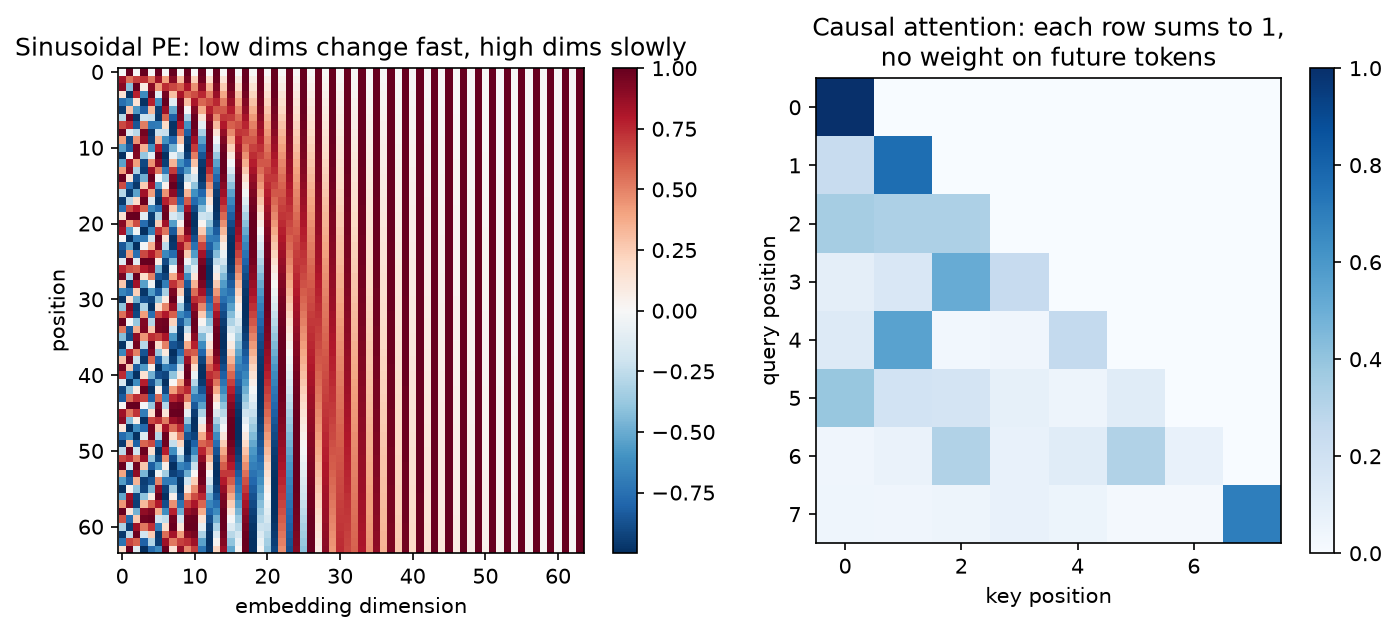
左圖:每個位置得到獨特的 sin / cos 組合,低維度變化快(分辨相鄰位置)、高維度變化慢(分辨遠距離)。右圖:causal mask 下的注意力權重,上三角全為 0,每列總和為 1。
Transformer Block
text
x ─► LayerNorm ─► Multi-Head Attention ─► (+) ─► LayerNorm ─► FFN (Linear → GELU → Linear) ─► (+) ─► 輸出
│                                          ▲  │                                                ▲
└──────────────── residual ────────────────┘ └─────────────────── residual ───────────────────┘| 元件 | 作用 |
|---|---|
| Residual connection | 梯度直接回傳,能疊很深(同 ResNet) |
| LayerNorm | 穩定訓練;現代模型多放在子層之前(pre-norm) |
| FFN | 每個位置各自通過的兩層 MLP,隱藏層通常是 |
python
layer = nn.TransformerEncoderLayer(d_model=64, nhead=8, dim_feedforward=256,
                                   activation="gelu", batch_first=True, norm_first=True)
encoder = nn.TransformerEncoder(layer, num_layers=4)
pad_mask = torch.zeros(2, 10, dtype=torch.bool); pad_mask[1, 7:] = True   # True = padding
encoder(x, src_key_padding_mask=pad_mask).shape                           # torch.Size([2, 10, 64])
三種架構
| 架構 | 注意力 | 預訓練目標 | 代表模型 | 適合 |
|---|---|---|---|---|
| Encoder-only | 雙向 | 遮蔽語言模型 (MLM):猜被遮住的 token | BERT、ESM-2、DNABERT | 分類、序列標註、抽 embedding |
| Decoder-only | causal | 下一個 token 預測 | GPT、Llama、ProGen | 生成、LLM |
| Encoder-decoder | 雙向 + cross | 序列到序列 | T5、原始 Transformer | 翻譯、摘要 |
LLM 的訓練、對齊與使用見 LLM 基礎;fine-tune(LoRA / PEFT)見 Fine-Tuning。
長序列的問題
attention 矩陣是
| 對策 | 例子 |
|---|---|
| 高效實作(不改數學) | FlashAttention(F.scaled_dot_product_attention 自動使用) |
| 先用 CNN / pooling 縮短序列再接 Transformer | Enformer |
| 稀疏 / 局部 attention | Longformer、BigBird |
| 非 attention 的長序列架構 | 狀態空間模型 (state space model)、Hyena 類(HyenaDNA、Caduceus) |
常見誤解
| 誤解 | 實際 |
|---|---|
| attention 權重 = 模型的解釋 | 權重高不等於因果上重要;多層、多 head 混合後更難解讀。需要解釋時用歸因方法並以實驗驗證 |
| Transformer 一定比較好 | 小資料、短序列時 CNN / LSTM / 樹模型常相當,且便宜得多 |
| 模型越大越好 | 標註品質、切分方式(同源序列洩漏)的影響常大於模型大小 |
| attention map 看起來像蛋白質接觸圖就代表學到結構 | ESM 的部分 head 確實與接觸圖相關,但仍需以結構資料驗證 |