外觀
Machine Learning › 前處理 › 特徵縮放
特徵縮放 (Feature Scaling)
把特徵轉到可比較的尺度,避免數值範圍大的變數主導距離計算或正則化懲罰。縮放參數(平均、SD、最小、最大)只能用訓練資料估計,再套用到測試資料。
哪些模型需要
| 需要縮放 | 原因 | 不需要縮放 |
|---|---|---|
| KNN、K-Means、階層式分群 | 以距離為基礎 | 決策樹、隨機森林 |
| SVM(尤其 RBF kernel) | 距離 / 內積 | Gradient Boosting、XGBoost |
| 有正則化的線性 / 邏輯斯迴歸(Ridge、Lasso) | 懲罰對係數大小敏感 | 未正則化的線性迴歸(預測不變,只影響係數解讀) |
| PCA | 變異大的變數主導主成分 | Naive Bayes |
| 神經網路、梯度下降類模型 | 收斂速度與穩定性 | — |
方法
| Scaler | 公式 / 做法 | 結果 | 適用 |
|---|---|---|---|
StandardScaler | 平均 0、SD 1 | 大多數情況的預設 | |
MinMaxScaler | [0, 1] | 需要固定範圍(影像像素、部分神經網路);對離群值很敏感 | |
RobustScaler | 中位數 0 | 有離群值 | |
MaxAbsScaler | [−1, 1] | 稀疏資料(不破壞 0 值) | |
Normalizer | 每一列縮放到單位長度 | 每列 L2 範數 = 1 | 文字向量、cosine 相似度 |
QuantileTransformer、PowerTransformer | 非線性轉換成均勻 / 近似常態 | 改變分布形狀 | 嚴重偏態 |
log(FunctionTransformer(np.log1p)) | 壓縮右尾 | 改變分布形狀 | 金額、計數、表現量 |
python
import numpy as np
from sklearn.preprocessing import (StandardScaler, MinMaxScaler, RobustScaler,
                                   Normalizer, FunctionTransformer)

x = np.array([[1.], [2.], [3.], [4.], [100.]])            # 一個離群值
StandardScaler().fit_transform(x).ravel()   # [-0.54, -0.51, -0.49, -0.46, 2.0]
MinMaxScaler().fit_transform(x).ravel()     # [0.00, 0.01, 0.02, 0.03, 1.0]  ← 正常值全擠在 0 附近
RobustScaler().fit_transform(x).ravel()     # [-1.0, -0.5, 0.0, 0.5, 48.5]   ← 正常值保持分開
Normalizer().fit_transform([[3, 4]])        # [[0.6, 0.8]]  逐列

# 實務:放進 pipeline,自動只在訓練 fold 上 fit
from sklearn.pipeline import make_pipeline
from sklearn.neighbors import KNeighborsClassifier
from sklearn.model_selection import GridSearchCV

pipe = make_pipeline(StandardScaler(), KNeighborsClassifier())
search = GridSearchCV(pipe, {"kneighborsclassifier__n_neighbors": range(1, 50, 2)}, cv=5)
search.fit(X_train, y_train)

# log 轉換 + 標準化
make_pipeline(FunctionTransformer(np.log1p), StandardScaler())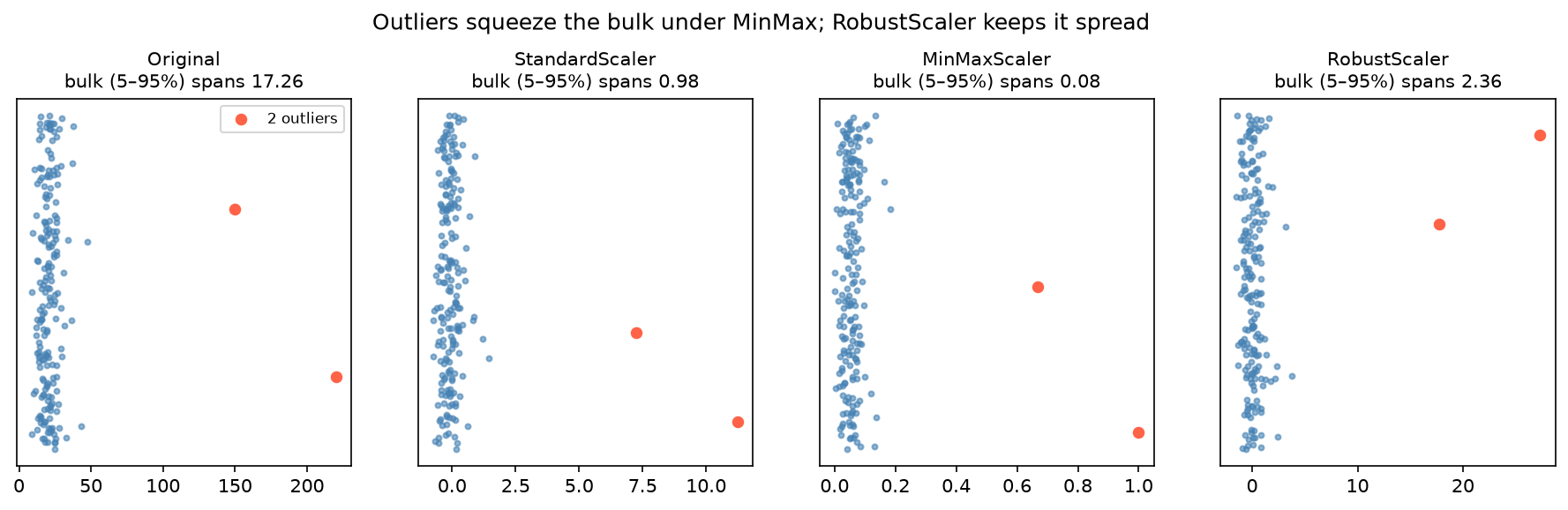
右偏資料加兩個離群值:MinMax 把主體壓縮到 0.08 的寬度內;StandardScaler 的平均與 SD 也被拉動;RobustScaler 用中位數與 IQR,主體仍分得開。
縮放(標準化、MinMax)只是平移與伸縮,不改變分布形狀;偏態資料標準化後仍然偏態。要改變形狀得用 log、Box-Cox 等非線性轉換,見 資料轉換。
生資:逐樣本正規化 vs 逐特徵縮放
| 逐樣本(列)正規化 | 逐特徵(欄)縮放 | |
|---|---|---|
| 目的 | 消除樣本間的技術差異(定序深度、上機量) | 讓特徵在模型中可比較 |
| 例子 | CPM / TPM、DESeq2 size factor、log1p(CPM) | StandardScaler(基因 z-score) |
| 順序 | 先做 | 後做(在 pipeline 內) |
逐樣本正規化只用該樣本自己的資料,不會跨樣本洩漏;但 DESeq2 size factor、quantile normalization、ComBat 批次校正這類用到所有樣本的方法,嚴格來說也要只在訓練資料上估計。
常見錯誤
| 錯誤 | 改正 |
|---|---|
在全資料上 fit_transform 後才切分 | 先切分,或放進 Pipeline |
測試資料另外 fit_transform | 測試資料只能 transform |
| 對 one-hot 欄位也標準化後解讀係數 | 可以做,但係數意義改變;通常只縮放數值欄 |
| 以為樹模型需要縮放 | 樹只看排序,縮放不影響結果 |