外觀
Machine Learning › 監督式學習 › 集成方法 › Gradient Boosting
梯度提升 (Gradient Boosting)
依序加入淺樹,每棵新樹擬合目前模型損失函數的負梯度(平方損失時就是殘差),再乘上學習率加進模型。等於在「函數空間」做梯度下降。是表格資料上最常勝出的模型家族(XGBoost、LightGBM、CatBoost 都屬於這一類)。
關鍵參數
| 參數 | 作用 | 常用範圍 |
|---|---|---|
learning_rate (η) | 每棵樹的貢獻縮放;越小越穩但需要越多樹 | 0.01–0.1 |
n_estimators / max_iter | 樹的數量;會過擬合,用 early stopping 決定 | 數百到數千 |
max_depth / max_leaf_nodes | 每棵樹的複雜度(交互作用的階數) | 深度 3–8 |
subsample | 每棵樹用的樣本比例(< 1 = stochastic GB) | 0.5–0.9 |
min_samples_leaf | 葉節點最少樣本 | 依資料量 |
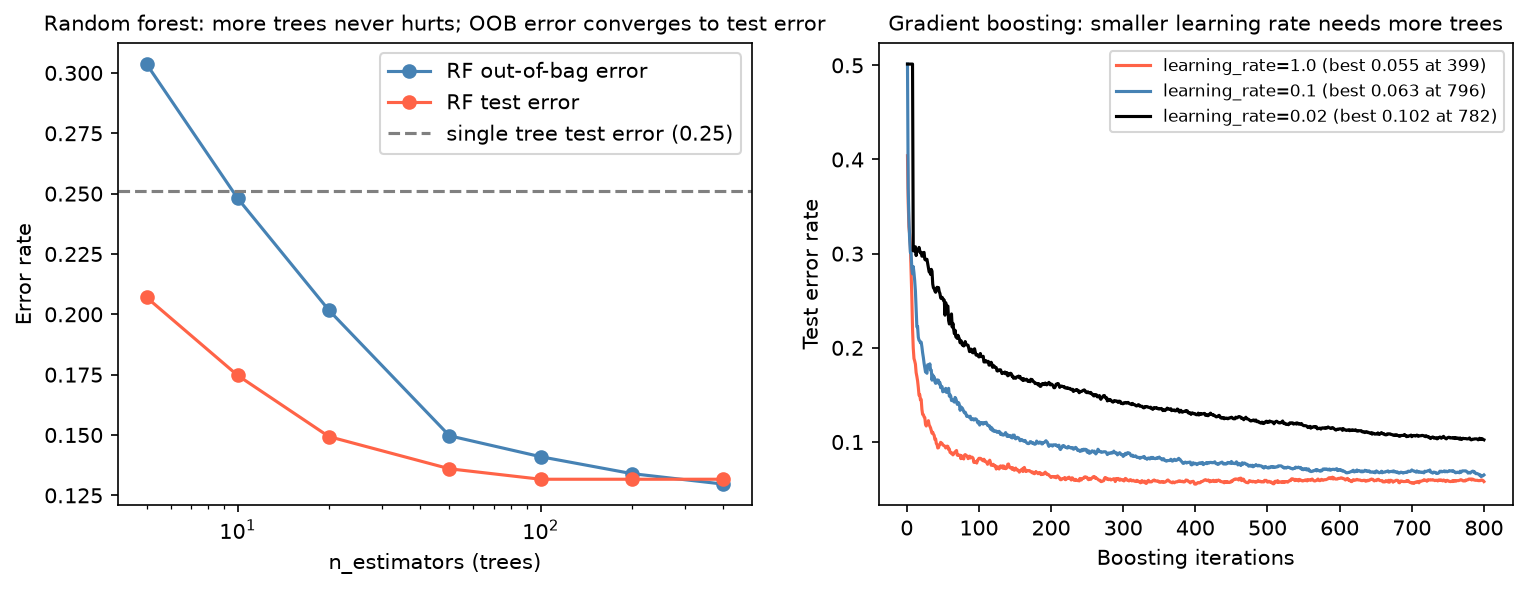
右圖:學習率 1.0 很快收斂;0.1 需要約 800 輪;0.02 在 800 輪時還沒收斂。學習率與樹數必須一起調,實務做法是固定較小的學習率,用 early stopping 決定樹數。
兩種 sklearn 實作
GradientBoostingClassifier/Regressor | HistGradientBoostingClassifier/Regressor | |
|---|---|---|
| 速度 | 慢(精確分裂) | 快很多(特徵先分箱成 ≤ 255 個 bin),適合數萬筆以上 |
| 缺失值 | 需補值 | 原生支援 NaN |
| 類別特徵 | 需編碼 | categorical_features="from_dtype" 原生支援 |
| Early stopping | n_iter_no_change + validation_fraction | early_stopping="auto"(n > 10,000 時自動開啟) |
| 對應 | 經典版本 | 類似 LightGBM |
python
from sklearn.ensemble import GradientBoostingClassifier, HistGradientBoostingClassifier

# 承乳癌範例
# 1. 經典版 + early stopping:設很大的 n_estimators,讓驗證分數決定何時停
gb = GradientBoostingClassifier(n_estimators=1000, learning_rate=0.05, max_depth=3, subsample=0.8,
                                validation_fraction=0.2, n_iter_no_change=20, random_state=0)
gb.fit(X_train, y_train)
gb.n_estimators_          # 113:實際只用了 113 棵就停止

# 2. HistGradientBoosting:預設值就很強,大資料首選
hgb = HistGradientBoostingClassifier(learning_rate=0.05, max_iter=1000, early_stopping=True,
                                     random_state=0)
hgb.fit(X_train, y_train)
hgb.n_iter_               # 80

# 其他損失:迴歸可用 loss="absolute_error"、"quantile"(預測區間)、"poisson"(計數)
乳癌資料(398 筆)CV AUC:Gradient Boosting 0.985、HistGB 0.983,都略低於邏輯斯迴歸 0.992。樣本小、關係近線性時,boosting 沒有優勢。
調參順序
text
1. 固定 learning_rate = 0.05–0.1,開 early stopping
2. 調樹的複雜度:max_depth / max_leaf_nodes、min_samples_leaf
3. 調隨機性:subsample、max_features(或 XGBoost 的 colsample_bytree)
4. 調正則化:l2_regularization(HistGB)、reg_lambda / reg_alpha(XGBoost)
5. 最後把 learning_rate 降低、樹數加多做最後提升
調參方法見 超參數調整。
特性
| 優點 | 缺點 |
|---|---|
| 表格資料上準確度通常最高 | 參數多、需要調 |
| 支援各種損失(分位數、Poisson…) | 依序訓練(樹內可平行,樹間不行) |
| HistGB / XGBoost / LightGBM 原生處理缺失 | 樹數過多會過擬合(不像隨機森林) |
| — | 對標籤雜訊比隨機森林敏感 |
| 函式庫 | 特色 |
|---|---|
sklearn HistGradientBoosting* | 不用額外安裝、與 pipeline 整合最好 |
| XGBoost | 最成熟、GPU、競賽常用 |
| LightGBM | leaf-wise 生長,大資料最快 |
| CatBoost | 類別特徵處理最好(ordered target encoding) |
Boosting 和 隨機森林 的差別:隨機森林平均許多「各自很強、但變異高」的深樹;boosting 依序累加許多「各自很弱」的淺樹。