外觀
Machine Learning › 監督式學習 › 分類 › 決策樹
決策樹:分類 (Decision Tree Classification)
決策樹反覆挑一個特徵與切點,把資料分成更「純」的子群,直到停止條件。結果是一組 if-else 規則,容易解讀,但單棵樹很不穩定、容易過擬合,實務上多作為 隨機森林、Gradient Boosting 的基本單元。迴歸版本見 迴歸樹。
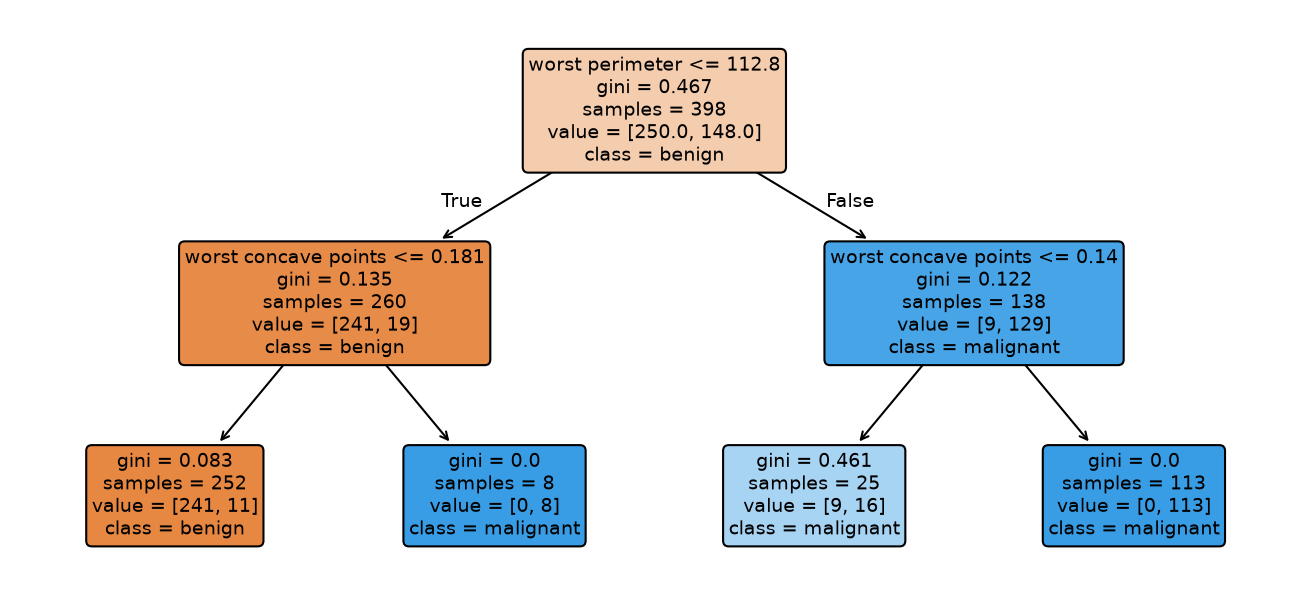
乳癌資料深度 2 的樹:先看 worst perimeter,再看 worst concave points。每個節點顯示樣本數、value = [良性, 惡性] 與 Gini 不純度。最左葉 252 筆中有 11 筆惡性被歸為良性。這棵 4 個葉節點的樹測試 accuracy 0.906。
分裂準則
criterion | 公式 | 說明 |
|---|---|---|
"gini"(預設) | 計算快 | |
"entropy" / "log_loss" | 資訊增益;結果通常與 Gini 相近 |
每次分裂選「子節點加權不純度下降最多」的特徵與切點(貪婪演算法,不保證全域最佳)。
控制複雜度
| 參數 | 作用 |
|---|---|
max_depth | 最大深度 |
min_samples_leaf | 葉節點最少樣本數(常是最有效的單一參數) |
min_samples_split | 節點至少要有多少樣本才能再分 |
max_leaf_nodes | 葉節點上限 |
ccp_alpha | 成本複雜度剪枝 (cost-complexity pruning):長完再剪 |
class_weight | 不平衡資料 |
python
from sklearn.tree import DecisionTreeClassifier, export_text, plot_tree
from sklearn.model_selection import GridSearchCV, StratifiedKFold

# 承乳癌範例
full = DecisionTreeClassifier(random_state=0).fit(X_train, y_train)
full.get_depth(), full.get_n_leaves()      # 8 層、19 葉
full.score(X_train, y_train)               # 1.0   ← 記住了訓練資料
full.score(X_test, y_test)                 # 0.901

search = GridSearchCV(DecisionTreeClassifier(random_state=0),
                      {"max_depth": [2, 3, 4, 5, None], "min_samples_leaf": [1, 5, 10],
                       "ccp_alpha": [0, 0.005, 0.01, 0.02]},
                      cv=StratifiedKFold(5, shuffle=True, random_state=0), scoring="roc_auc")
search.fit(X_train, y_train)               # 最佳:min_samples_leaf=5,CV AUC 0.954

# 讀規則
print(export_text(DecisionTreeClassifier(max_depth=2).fit(X_train, y_train),
                  feature_names=list(X.columns)))
# |--- worst perimeter <= 112.80
# |   |--- worst concave points <= 0.18  → class 0
# ...
plot_tree(search.best_estimator_, feature_names=list(X.columns), filled=True, max_depth=3)
調過參的單棵樹 CV AUC 0.954,仍明顯低於邏輯斯迴歸(0.992)與隨機森林(0.986)。
優缺點
| 優點 | 缺點 |
|---|---|
| 規則可讀,可直接給領域專家審查 | 不穩定:資料稍變,樹結構就大幅改變 |
| 不需縮放,能處理 NaN(sklearn ≥ 1.3) | 容易過擬合,需剪枝 |
| 自動捕捉非線性與交互作用 | 邊界只能是軸平行的矩形 |
| 混合數值與類別特徵 | 機率輸出粗糙(葉節點比例) |
| — | feature_importances_ 偏好高基數特徵,見 可解釋性 |
需要「可解釋的規則」又要準確度時:用淺樹當作解釋工具,主模型用集成方法;或檢查淺樹與集成模型的表現差距是否可以接受。